How to configure HiddifyManager properly
This page walks you through the first setup of the HiddifyManager admin panel and explains what each part of the panel does. Read it right after you install the panel, or whenever you want to know what a menu or setting is for.
Updated for HiddifyManager v14
Since v13 the panel opens Admin V2 by default, and in v14 the old (classic) admin pages redirect to it. The menu names on this page are the Admin V2 names. Most screenshots below were taken in an older version, so your screen will look different, but the ideas are the same.
The panel makes running proxies easier, but it cannot fix a blocked server or a broken domain. If you finish this page and your users still cannot connect, read Troubleshooting connectivity issues.
There is also a video walkthrough in Persian. It was recorded for an older version.
Before you start
You need:
- A server with a clean IP. A clean IP is one that is not blocked in your users' country. Check it with How to make sure the server's IP or domain is clean. If the IP is blocked, get a new IP or a new server.
- HiddifyManager installed, as described in the installation guide. At the end of the install you get your admin links. The admin link contains your secret path and your admin ID, so it works like a password. See the correct format of the admin link.
- A registered domain that is reachable. A domain is a name such as
example.comthat points to your server. See domain types and how to register them, then check that the domain is clean.
If a word on this page is new to you, see Basic concepts.
Open the admin panel for the first time
- If you used a one-click install link from a provider such as Vultr or OVH, wait about 10 minutes. You then get a one-time link that opens the admin page.

- If you installed over SSH, the admin links are printed in the terminal at the end of the install. Open one of the Secure (https, domain) links in your browser. Use the IP link only if no domain link works.
- If you lost the links, connect to your server over SSH and run:
The first time you open the admin page, the Quick setup wizard starts.
Quick setup
The wizard has a few short steps. You can change everything later in Settings.
- Welcome: choose the admin panel language and the country your users are in. The country selects settings that suit its filtering.
- Password: set a password for the admin area (at least 8 characters).
- Domains: point your domain to the server IPs shown on the page (an
Arecord for IPv4,AAAAfor IPv6). Then type your domain and press Enter. The panel detects the domain type by itself; tap the type to change it. You need at least one direct, CDN or subscription-only domain. - Protocols: pick the protocols you want to offer. Choose as few as you need.
- Nodes (optional): connect other Hiddify servers to manage them from this panel. You can skip this.
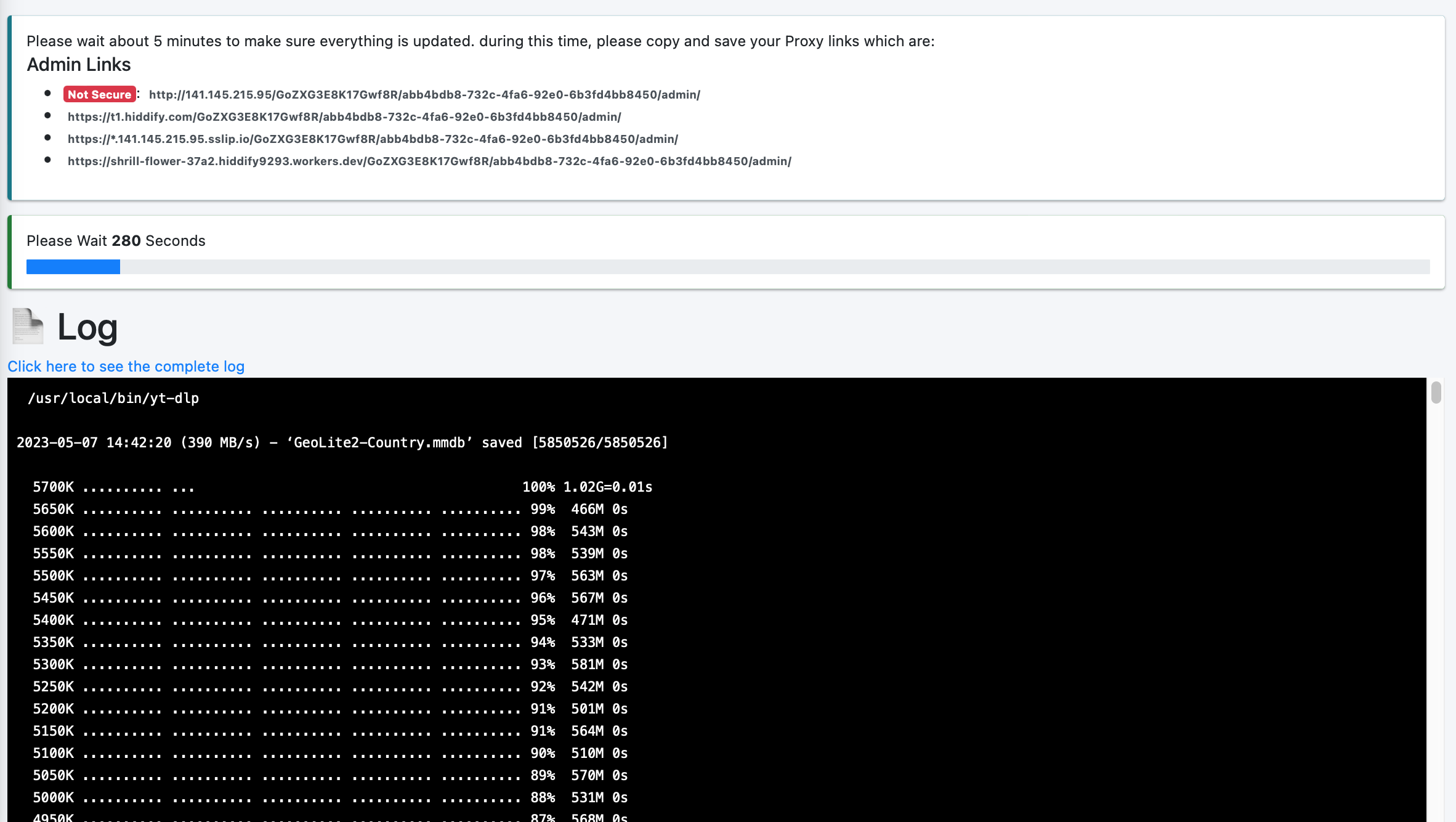
- Finish: review your choices and click Finish. The panel applies the configuration and reinstalls the services. This takes a few minutes. The log and your new admin links are shown while it runs.
When it finishes, the panel is ready to use. Copy the new admin links and keep them somewhere safe.

The admin menu
The Admin V2 sidebar has three groups:
- Manager: Dashboard, Users, Admins, Broadcast, Nodes and Utils.
- Settings: Proxy Editor, Domains, Settings, Backup, Actions (the Apply & status page) and, if you set one up, your Telegram bot.
- Help: links to the tutorials, bug reports and donations.
Dashboard
The Dashboard shows your server's resources (CPU, RAM, disk, traffic) as charts. If you use several servers (nodes), it also shows the health of each node.

Users
Here you create an account for each person who will use your proxies.
- Open Users and click the add button.
- Enter a name, the usage limit (in GB), the number of days (package days) and the reset mode.
- Save.
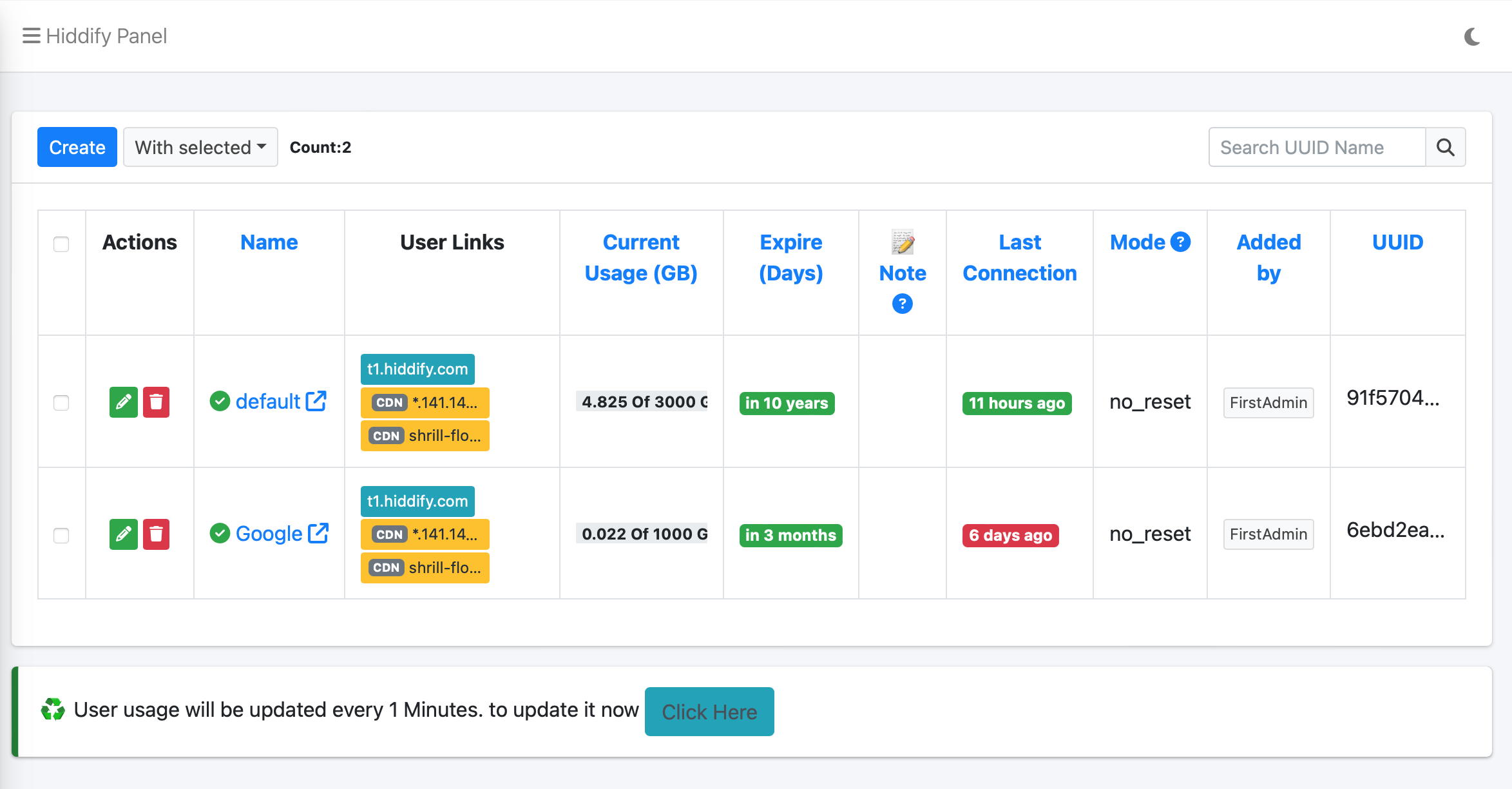
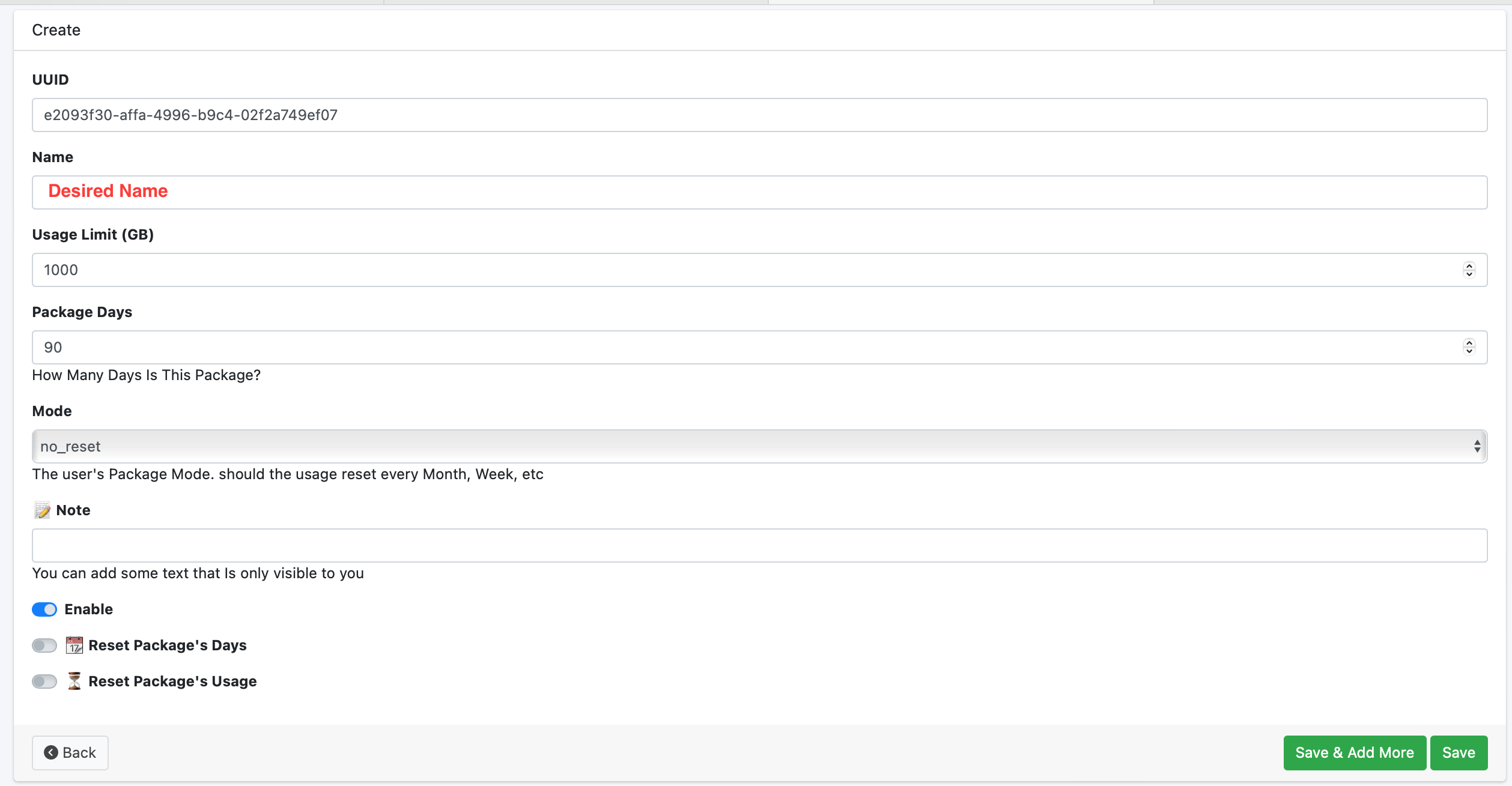
Each user has their own user page. Open it from the link next to the user. At the top of the user page the user can download a client app for their device. Further down are the user's configs.
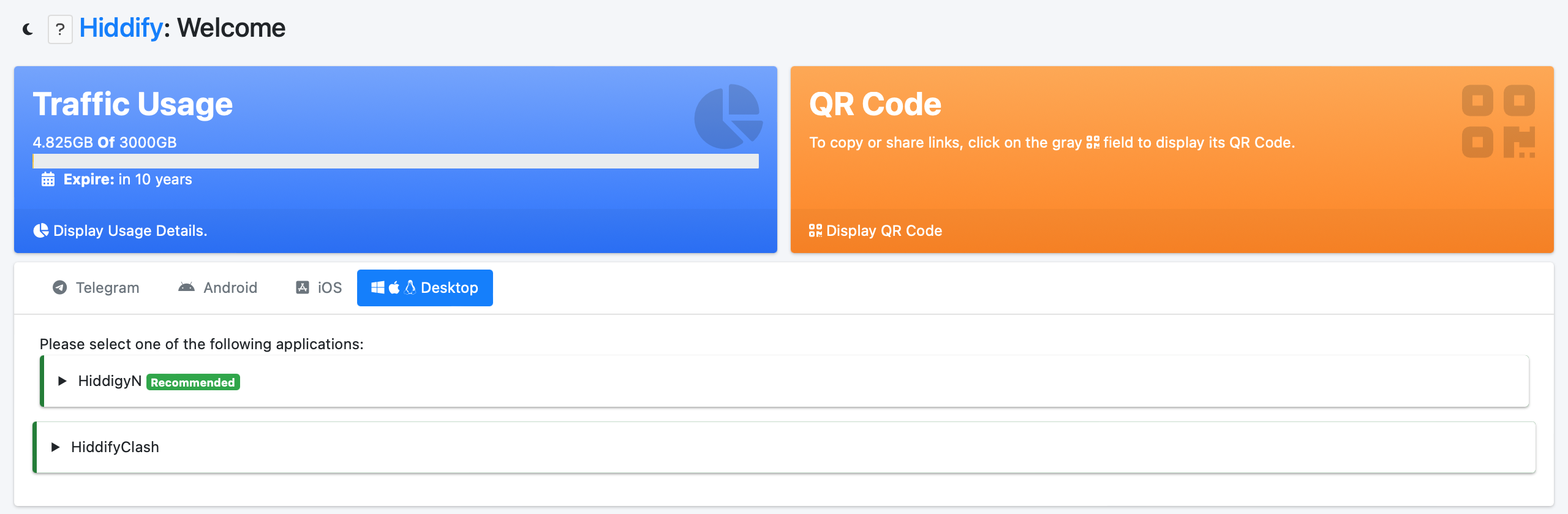

You can give users access in three ways:
- The user page link (recommended). The user opens it and finds everything there.
- The subscription link. A subscription link is one address that the app re-reads to get the latest configs. If you change your settings, the user's app updates itself.
- A single config link. It does not update. If you change your settings, you must send the user a new link.
For help connecting client apps, see the YouTube playlist and the client tutorials on the HiddifyManager tutorials page.
Admins
Here you create accounts for other people who help you manage the panel. Click the add button and fill in the form.
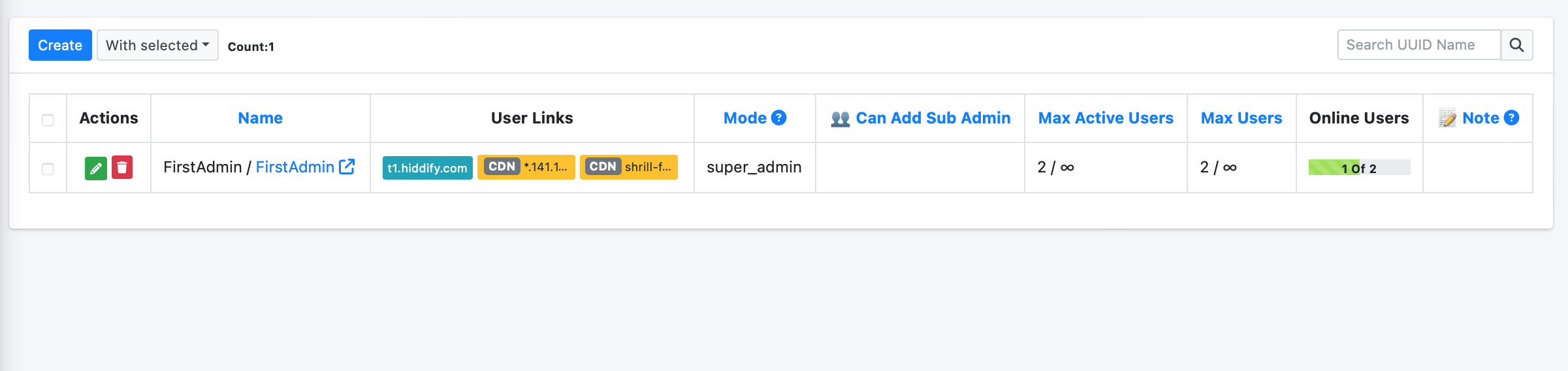
There are three admin types:
- Super admin: full access to the whole panel and all settings.
- Admin: can manage users and some settings.
- Agent: can only manage users.
For each admin you can:
- limit the number of users and active users;
- allow or forbid adding sub-admins;
- reset their password.
Note
Each admin's link contains their secret ID. If you change it, that admin's panel address changes completely. See the correct format of the admin link.
Domains
Open Settings → Domains to add or edit your domains. Each domain has a type, which says how users reach your server, and a TLS mode, which says which certificate or disguise it uses.
Domain types:
- Direct: the domain points straight to your server's IP. If the domain is on Cloudflare, keep the cloud off (DNS only).
- CDN: the domain goes through a CDN such as Cloudflare (orange cloud on). A CDN is a network of servers that sits between your users and your server, so your server's IP stays hidden.
- Relay: users connect to another server in between, which forwards the traffic to this one.
- Subscription only: used only for subscription links, with no proxies.
- Cloudflare Worker: Cloudflare workers are created for this domain automatically.
TLS modes: Valid TLS (a real certificate issued automatically), Fake, Reality and DNS (DNS tunnel only).
Changed in v13
The old separate types Auto CDN IP, Fake and Reality are no longer domain types. On upgrade, Auto CDN IP domains became CDN domains, and Fake and Reality domains became Direct domains with the Fake or Reality TLS mode.
Direct domain
Click the add button and fill in the form.

- Display name: shown in the users' apps instead of the domain. Use it if you don't want the domain to appear in the configs.
- Force configs to use these IPs / domains: leave it empty for a direct domain. It is mainly for CDN domains.
- Show configs of: choose which domains' configs users see when they open their user page through this domain.
Subscription-only domain
A subscription-only domain only serves subscription links. Because no proxy traffic goes through it, it is less likely to be blocked, so users can always update their configs.

After you link the subscription-only domain to your connection domains in Show configs of, open a user page through it. The configs on that page use your connection domains.
Tip: a subscription domain works best behind a CDN, so users can still update when your proxy domains are blocked. You can also use a PHP website for subscription links: see How to use a PHP site for sub links.
CDN domain
Click the add button and fill in the form.

- Display name: shown in the users' apps instead of the domain.
- Force configs to use these IPs / domains: put a clean Cloudflare IP here, or better, a normal DNS record (cloud off) that points to a clean IP. Then, when you need a new clean IP, you only update that DNS record and the panel and configs stay the same. To find clean IPs, see Guide for finding a clean Cloudflare IP. This field replaces the old Auto CDN IP mode: see Guide for using mode Auto_CDN_IP.
- Domain fronting: optional. Users' apps show another site's name (SNI) instead of your domain, so a filter only sees that other site. Use sites on the same CDN as your domain. In older versions this was a global setting; now it is set per CDN domain. See Guide for domain fronting.
- ECH: uses Encrypted Client Hello for this CDN domain. Turn on Enable TLS ECH in Settings first.
- Show configs of: choose which domains' configs users see on this domain's user page.
If you have many users and want to give each group its own domain, read How to use multi-CDN domains.
Other domain setups
- Relay domain: see How to add a relay domain.
- Fake TLS mode: see How to create and use a fake domain.
- Reality TLS mode: see How to use Reality.
- Cloudflare Worker: see How to set up and use Cloudflare workers.
Proxies and protocols
You turn protocols on or off in Settings → Settings, in the Proxies Settings group. The Proxy Editor lets advanced users edit each built-in proxy template.
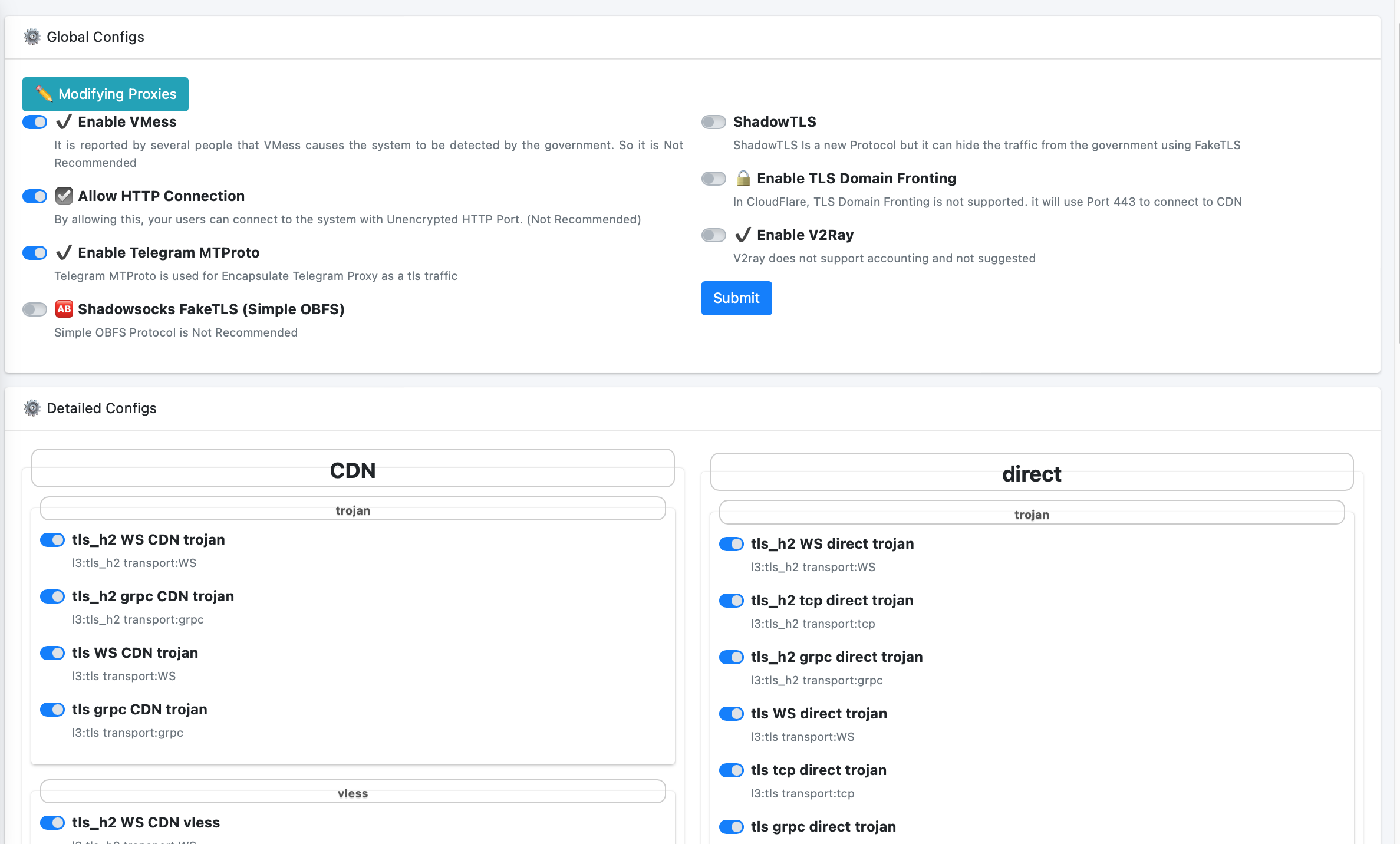
Note: plain HTTP connections are not encrypted. TLS connections are encrypted.
Settings
Open Settings → Settings. Common settings are shown first. Click Show advanced settings to see the rest, or use the search box. Settings marked Reinstall only take effect after a reinstall (see Actions). The groups are described below.
Admin Settings
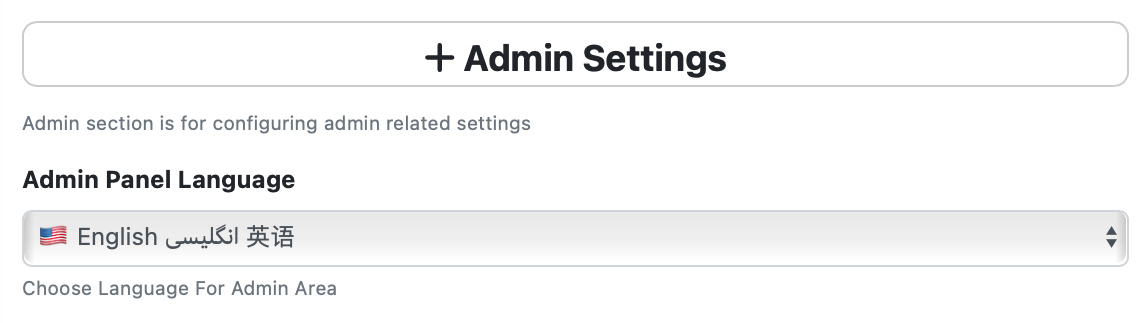
- Admin Panel Language: the language of the admin area. Admin V2 is translated into English and Persian; other languages fall back to English.
- Parent Panel (Multi Server): connect this panel to a central (parent) panel. You then define users on the parent panel, and the usage of all servers is added up there.
- Node name: a name for this server when it is part of a multi-server setup.
Customizing User Page
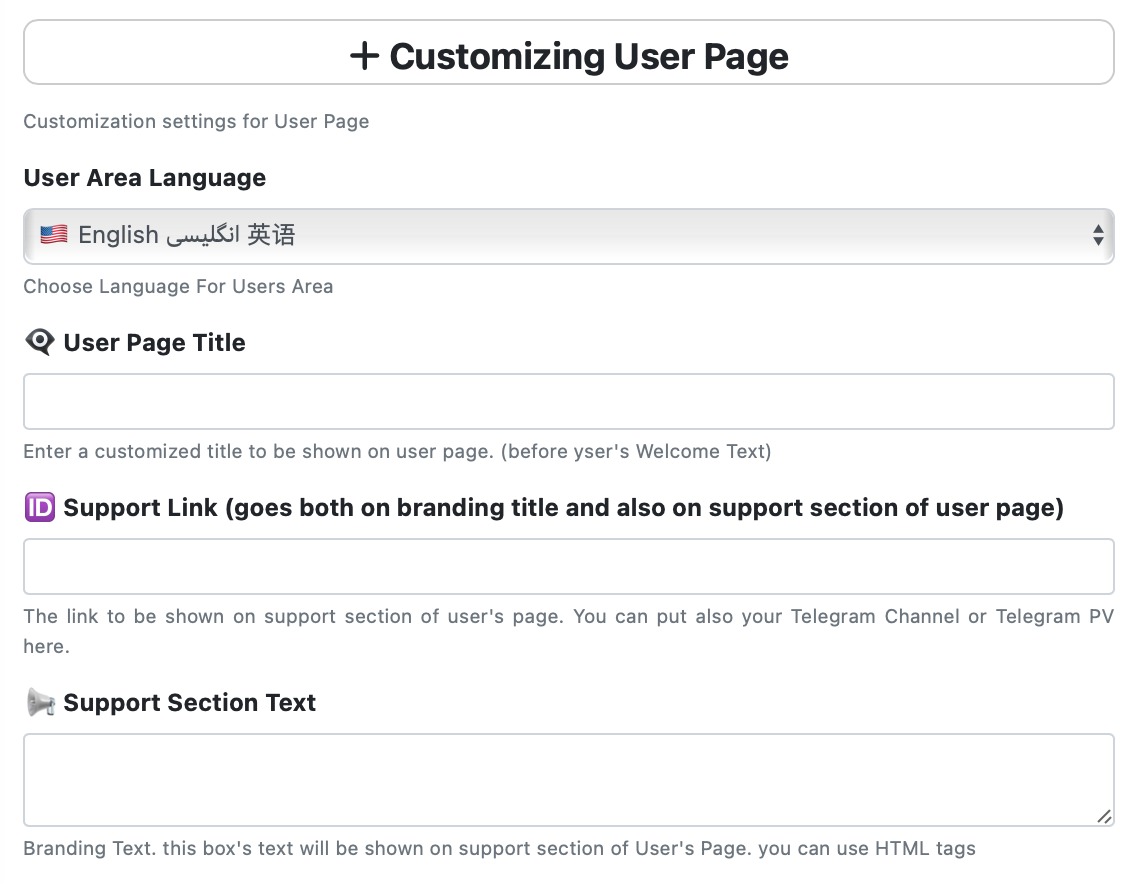
- User Area Language: the language of the user page.
- User Page Title: your brand name, shown at the top of the user page.
- Support Link: a link to your support channel.
- Support Section Text: a message shown in the support box of the user page.
General Settings
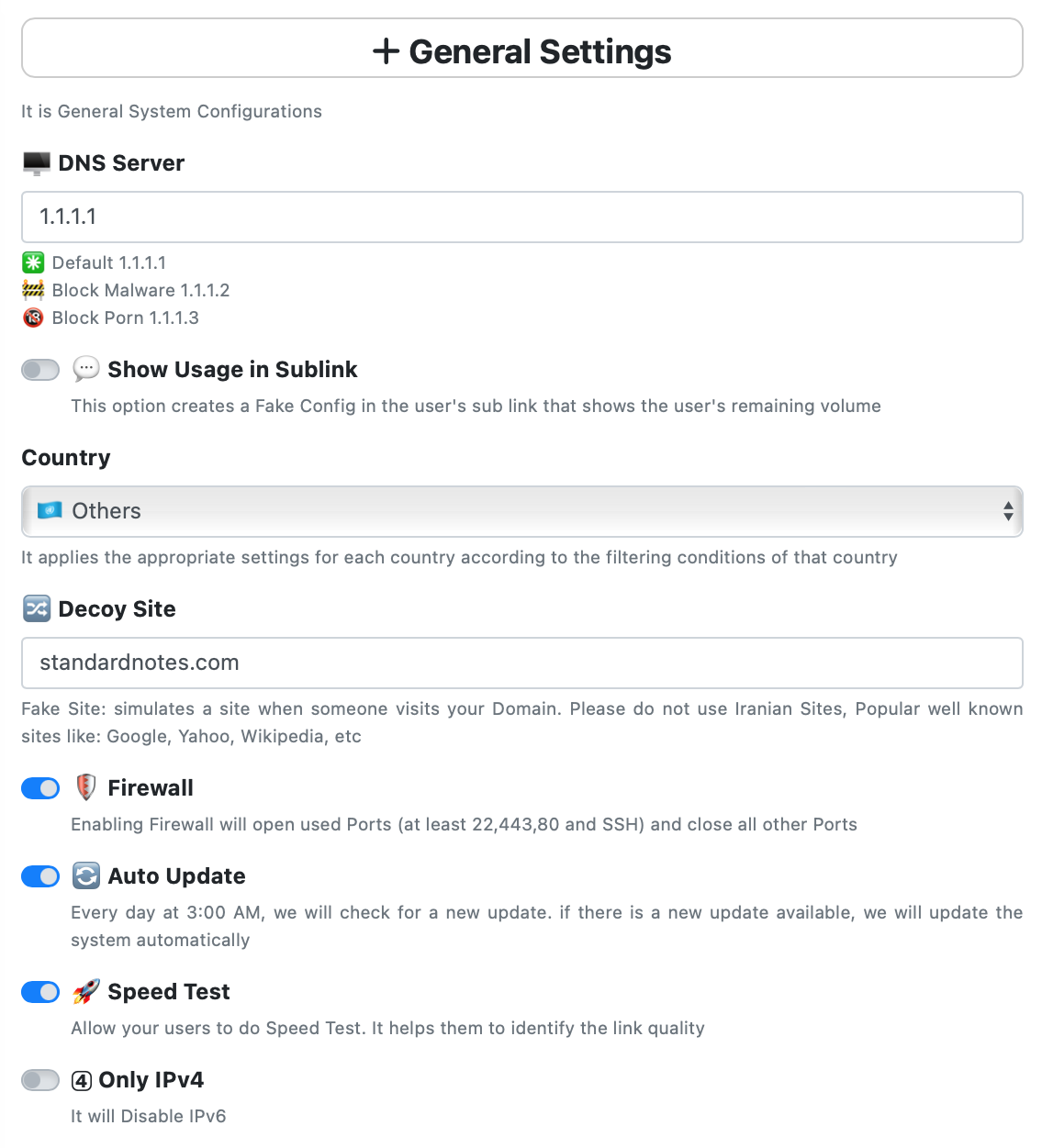
- Country: the country of your users. It selects settings that suit that country's filtering. Changing it needs a reinstall.
- Auto Update: lets the panel update itself.
- Only IPv4: turns off IPv6 on the server.
- Speed Test: lets users test their connection speed to your server.
- Decoy Site: a fake website. If someone (for example a filtering system) opens your domain directly, they see this site instead of your panel, which makes your server harder to identify. Do not use bank, payment, Iranian or very famous sites.
- Firewall: when on, only the ports Hiddify needs (such as 22, 80 and 443) stay open and all other ports are closed.
- DNS Server, Show Usage in Sublink, Torrent Block and Keep Backups (days) are also here. Keep Backups (days) deletes automatic backups older than this number of days;
0keeps all of them.
Proxies Settings
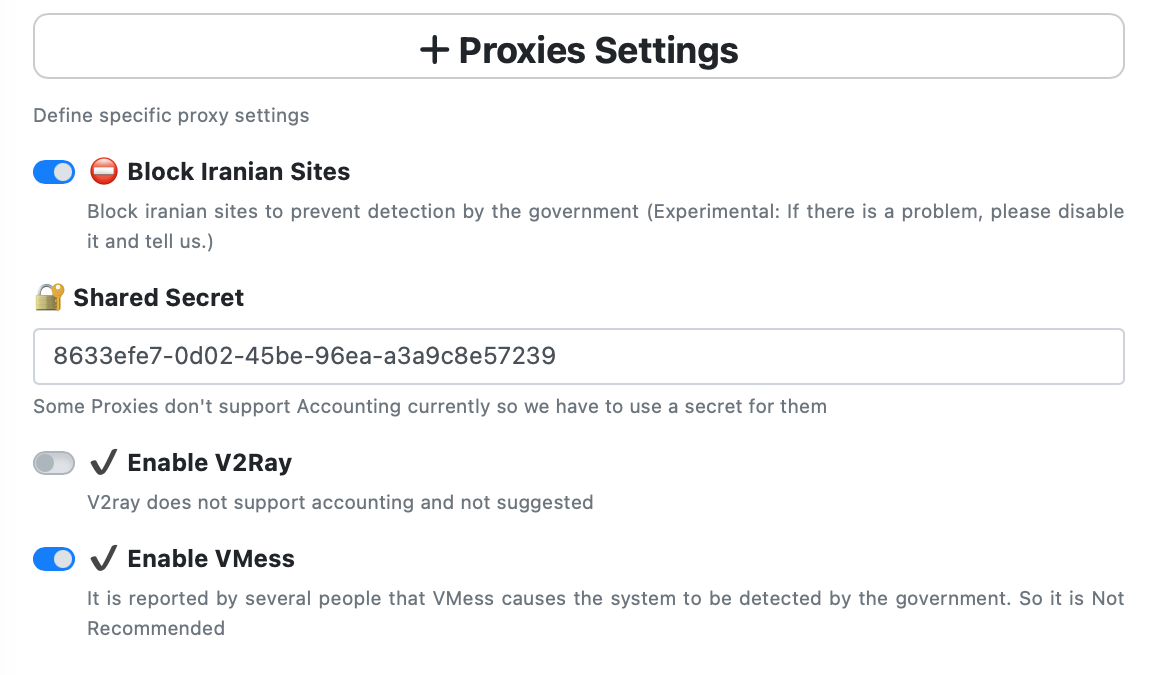
- Block Domestic Sites: blocks traffic from your server to Iranian sites and
.irdomains. This makes it harder for the filtering system to identify your server. We recommend turning it on. - Shared Secret: a password used by connections whose traffic is not counted per user.
- On/off switches for protocols and transports, for example VLess, Trojan, VMess, Reality, Websocket, gRPC, HTTPUpgrade, XHTTP, TCP, QUIC, Naive, AnyTLS, Snell and SOCKS.
Tip: in the Hiddify app, routing rules can send traffic for Iranian sites directly, without the proxy. This saves your server's traffic.
Removed settings
The old V2Ray switch is gone. The browser fingerprint setting (uTLS) is now under Advanced Settings.
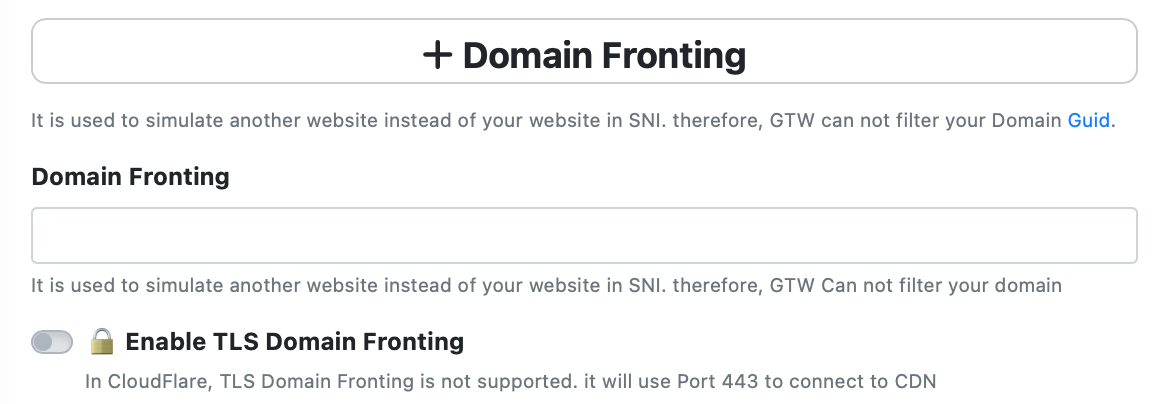
Domain fronting
The old global Domain Fronting settings group was removed. Domain fronting is now set on each CDN domain (see CDN domain). More information: Guide for domain fronting.
Telegram Configs
A Telegram proxy works only inside the Telegram app and helps users bypass Telegram filtering.
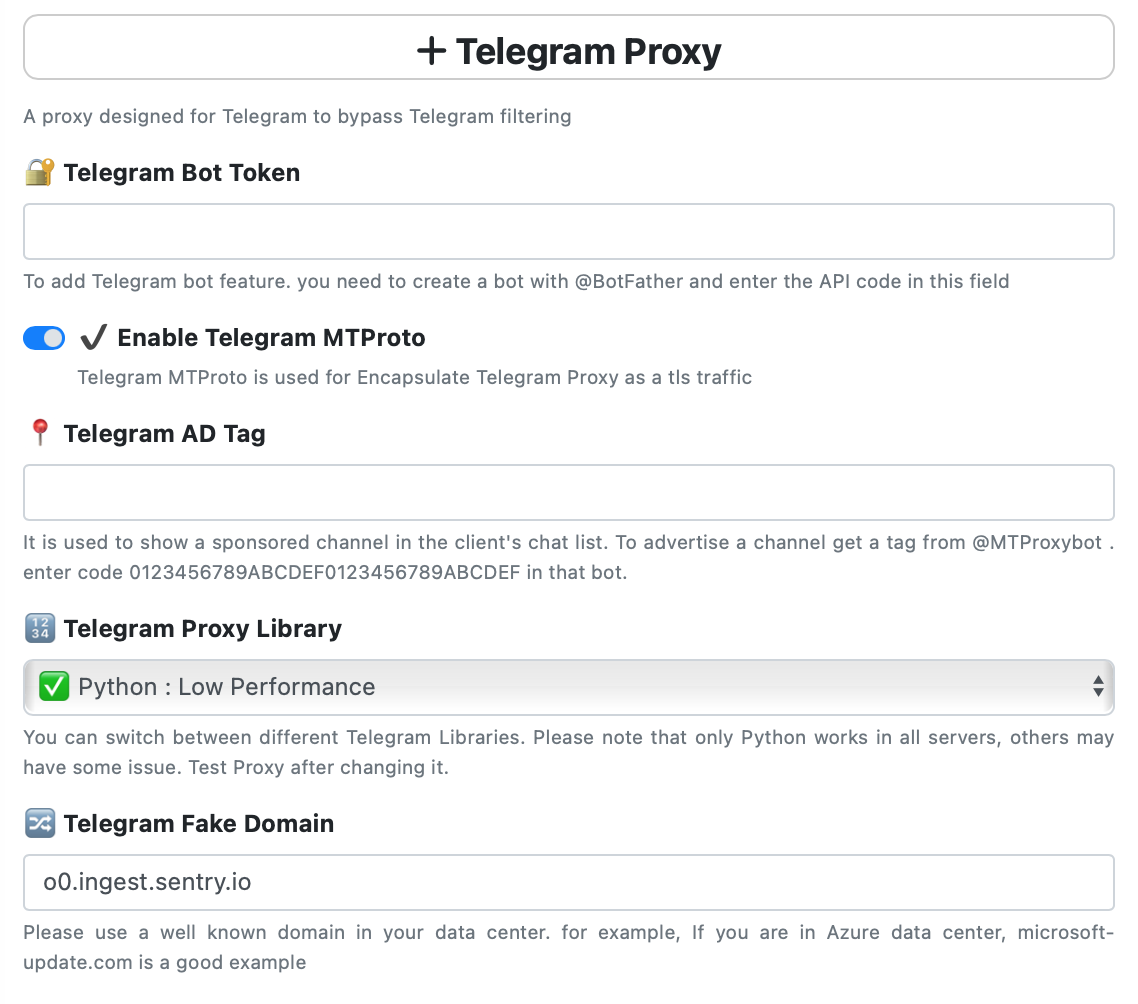
- MTProxy FakeTLS Enable: turns the Telegram proxy on or off.
- Telegram Web Proxy Enable: turns on the Telegram web proxy.
- Telegram AD Tag: an advertising tag that shows your channel in the user's Telegram chat list.
- Telegram Fake Domain: a domain whose name is used to disguise the proxy traffic.
- Telegram Bot Token: connects the panel to your Telegram bot. See How to set up and use the Telegram bot.
Changed in v14
The Telegram proxy now always uses telemt. The old choice of Telegram proxy library (Python, Erlang and others) was removed.
HTTP Configuration
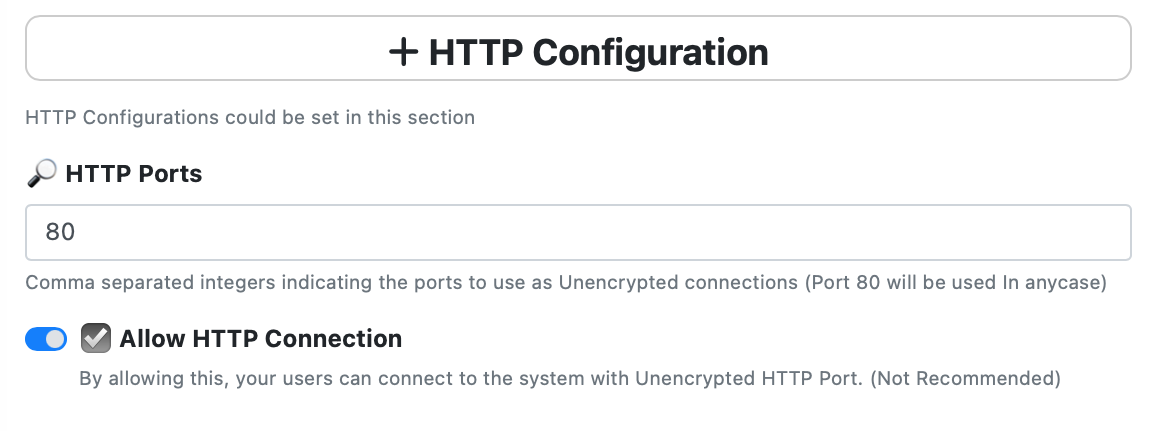
- Allow HTTP Connection: allows unencrypted HTTP connections. We don't recommend turning it on.
The custom HTTP port list was removed in v14. Proxies are served on ports 80 and 443 whenever possible.
TLS Settings
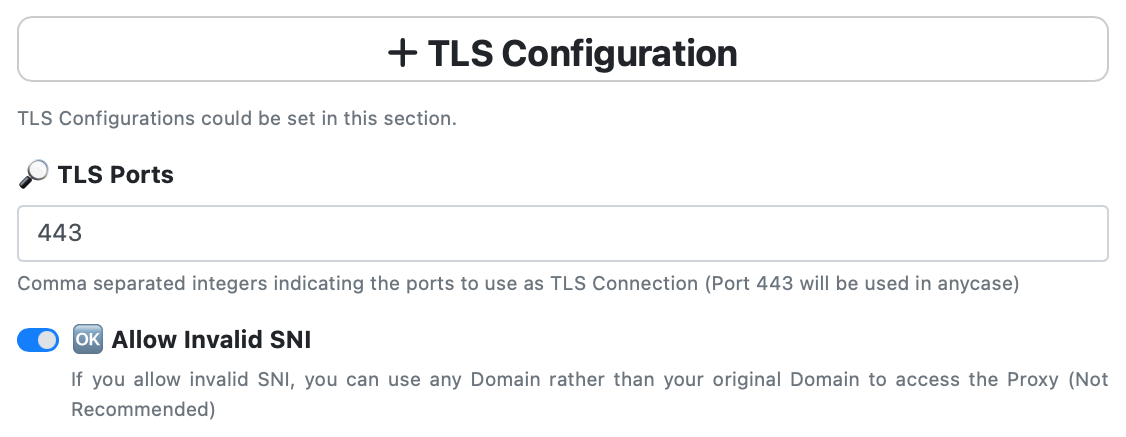
- Certificate (ACME) Email: the email used when the panel requests certificates.
- Enable TLS ECH: turns on Encrypted Client Hello support. You then enable it per CDN domain.
- Allow Invalid SNI.
The custom TLS port list was removed in v14. Since v14 the panel issues and stores certificates itself.
The TLS Trick group (TLS fragment, mixed SNI case, padding) is explained in How the TLS trick works.
Shadowsocks
Shadowsocks FakeTLS is a simple disguise that wraps data in TLS-looking packets to fool the filter.
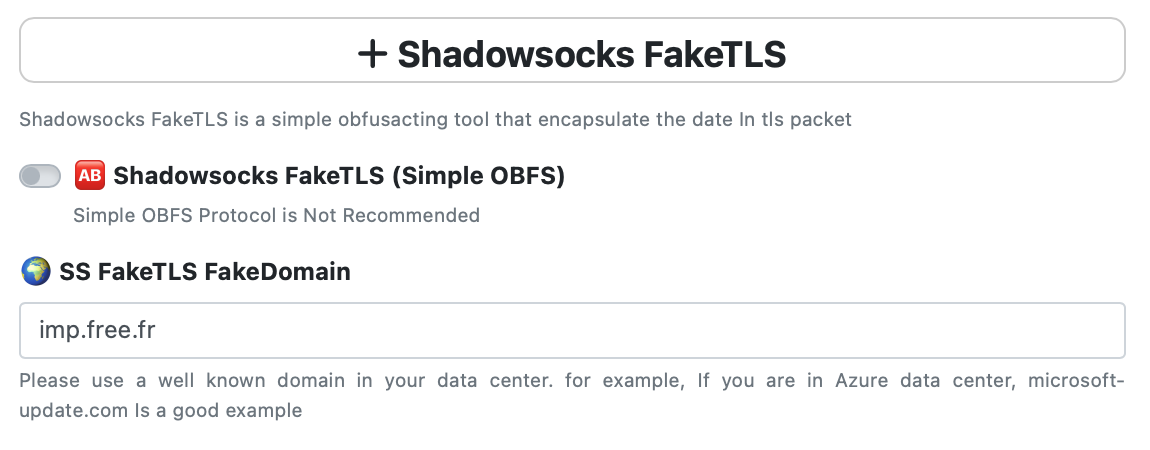
- Shadowsocks 2022: turns Shadowsocks 2022 on or off.
- Shadowsocks FakeTLS (Simple OBFS): we don't recommend it.
- SS FakeTLS FakeDomain: the fake domain used to disguise the packets.
ShadowTLS
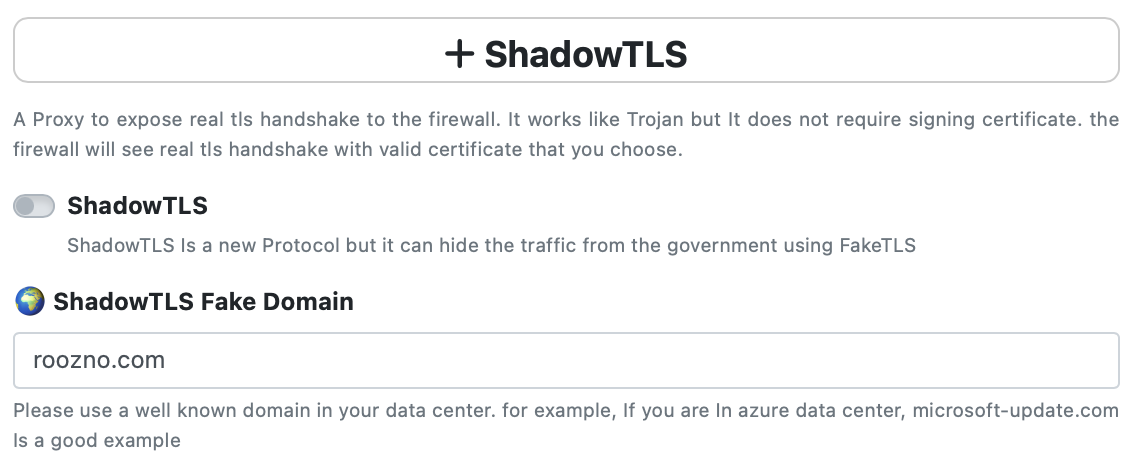
ShadowTLS shows the firewall a real TLS handshake with a valid certificate from a site you choose. Its switch and fake domain are in the Shadowsocks group.
Warning
The ShadowTLS service was removed from HiddifyManager in v13. Whether ShadowTLS configs still work is not confirmed, so don't rely on it.
Advanced Settings
These settings are for experienced users.
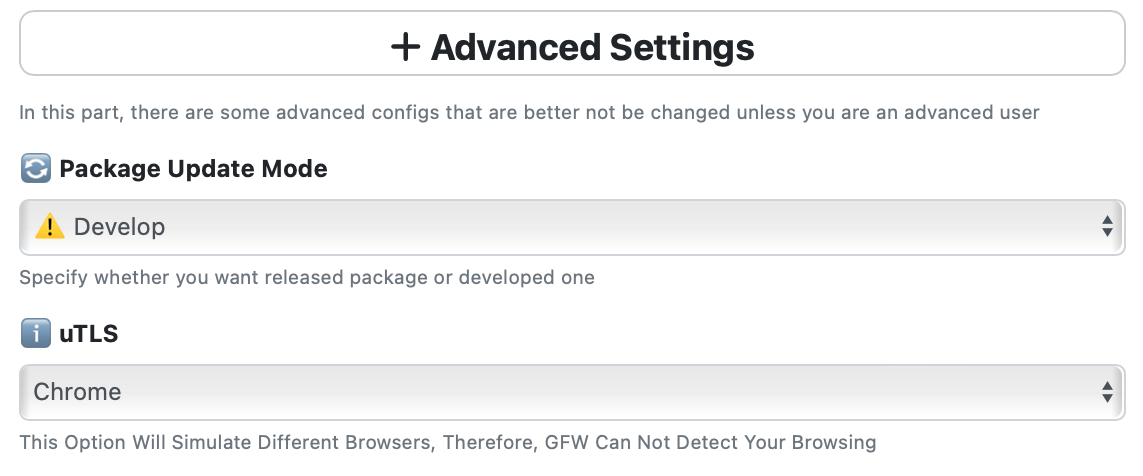
- Package Update Mode: choose Release (stable) or Beta updates.
- Common Proxy Core: which engine serves the shared proxies:
xray,hiddify_coreorboth. It replaces the old Core setting. - uTLS: which browser fingerprint the configs imitate (for example Chrome, Firefox, Safari, iOS or Android).
The parent panel link and the Telegram bot token moved to Admin Settings and Telegram Configs.
Very Advanced Settings
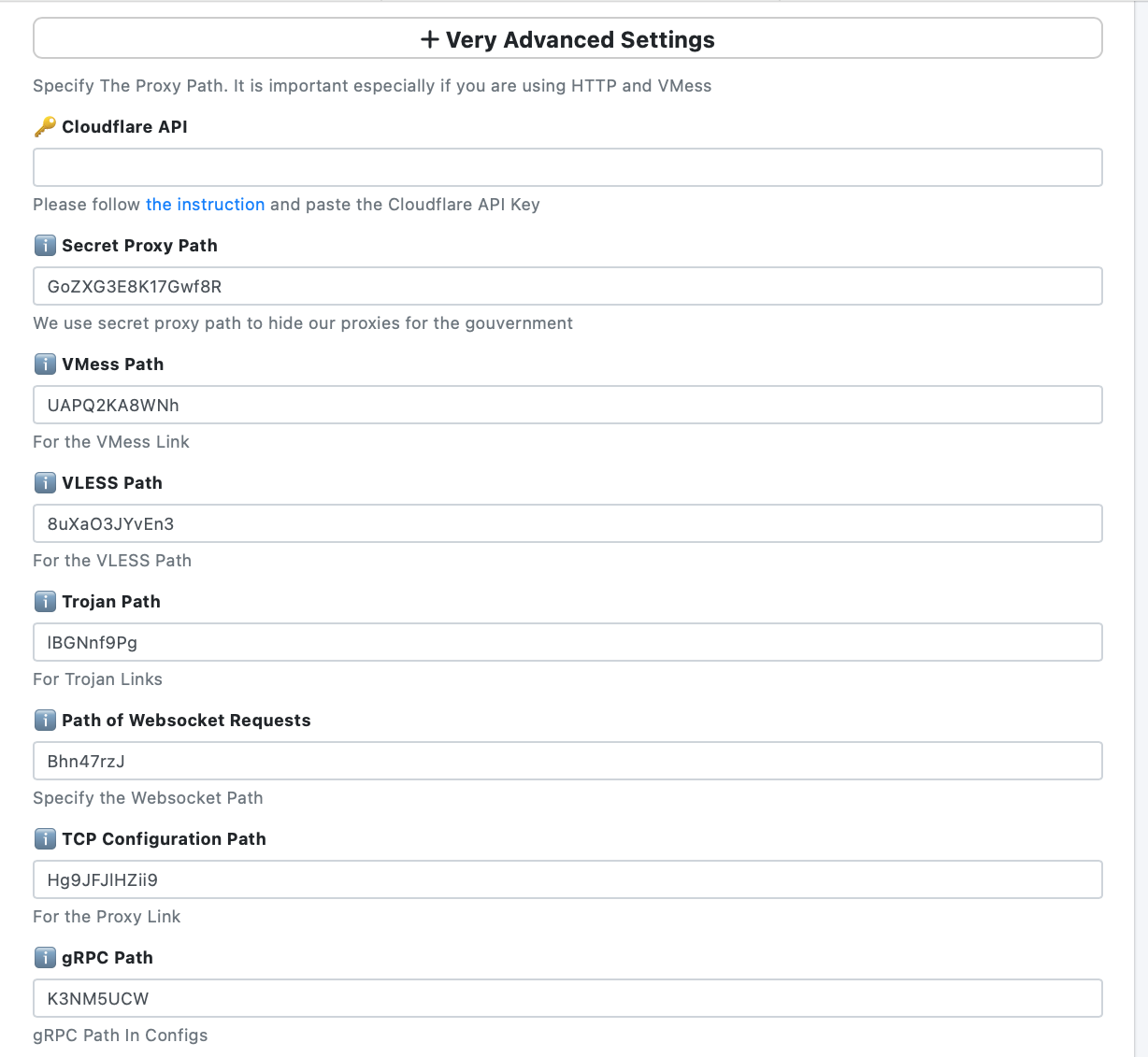
- Proxy Path for Admins and Proxy Path for Clients: the secret paths in your admin and user links. They hide your panel and connections from the filter. The panel sets them for you; change them only if you need to. If you change the admin path, your admin link changes.
- Cloudflare API.
The per-protocol path settings were hidden in v13.
WARP and Reality
- WARP: see How to activate WARP.
- Reality: see How to use Reality.
SSH Proxy
The SSH proxy service was removed in v13 and is no longer installed, even though its settings group may still appear. See SSH proxy setting.
Backup
Open Settings → Backup to make a backup of your panel or restore one.
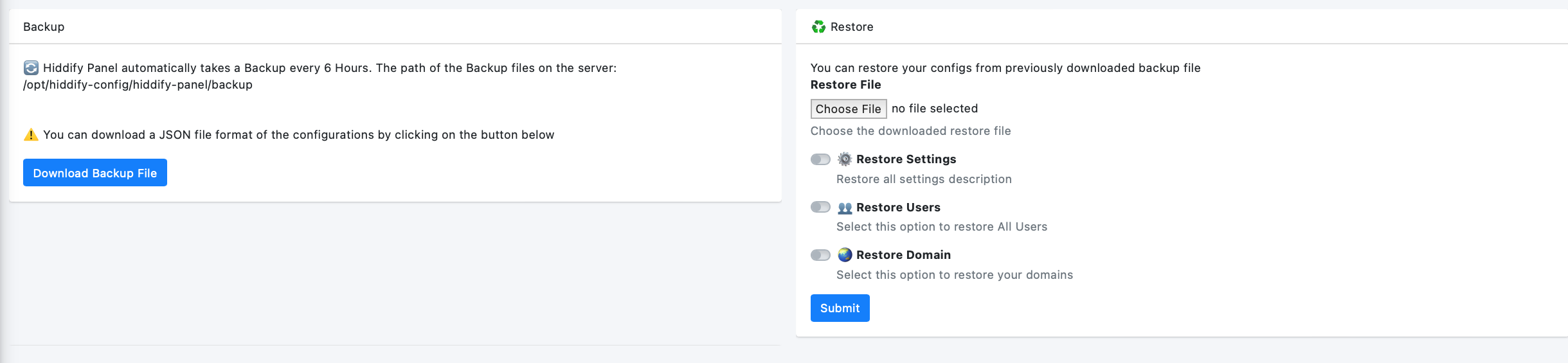
- Download backup saves everything in one
.jsonfile: settings, users, admins, domains, proxies and certificates. Keep the file safe: it contains passwords and private keys. - The panel also makes automatic backups on the server every 6 hours. They are listed under Backups on the server. If your Telegram bot is connected, each one is also sent to you on Telegram.
- When you restore, you choose which parts to bring back: Settings, Users and Domains.
Details: How to back up and restore.
Telegram bot
To set up and use the panel's Telegram bot, see How to set up and use the Telegram bot.
Actions (Apply & status)
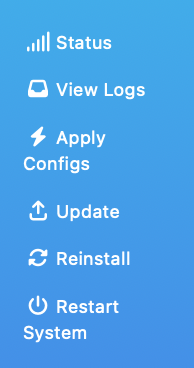
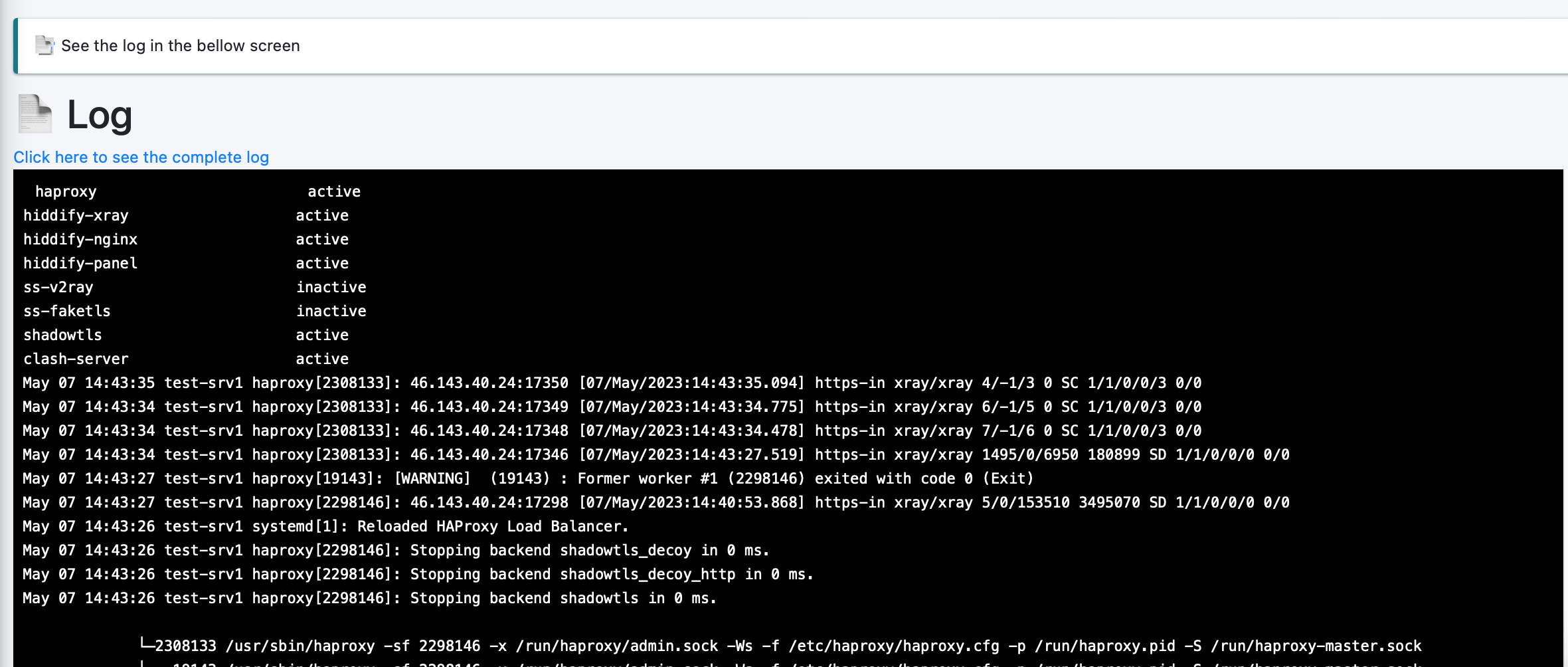
Open Settings → Actions. The Apply & status page lets you put changes into effect, update the server and see how everything is doing. Each action shows its log while it runs. You can leave the page; the action keeps running on the server.
Check status
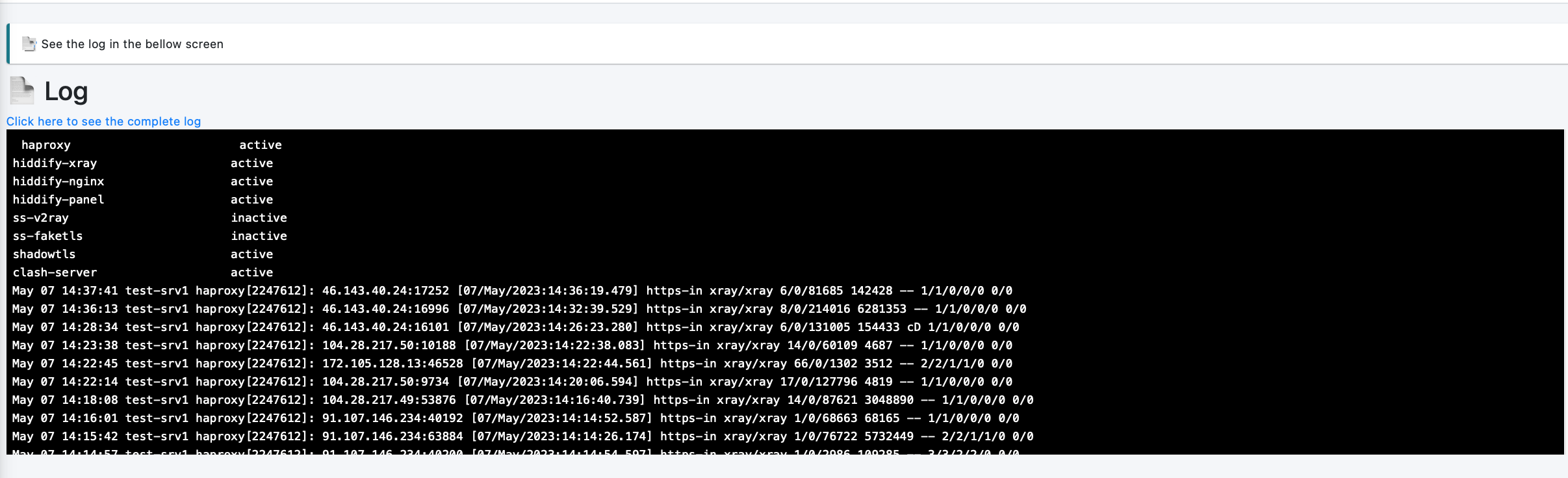
Shows whether each service is running, plus the server's public IP and WARP. It changes nothing.
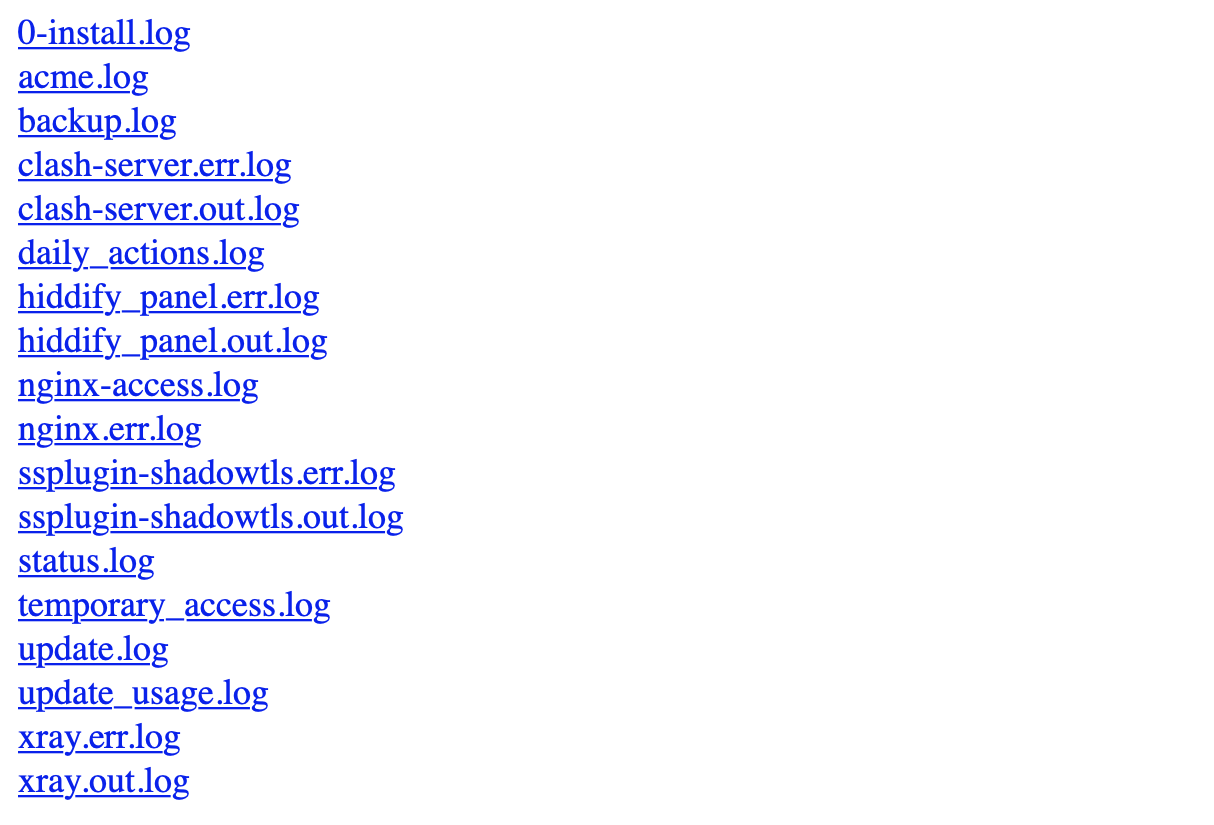
Logs
The Logs section lists what each action did. Click View to read a log.
Apply changes
Puts your settings, users and domain changes into effect. It is quick, and it is the usual choice after you change something.
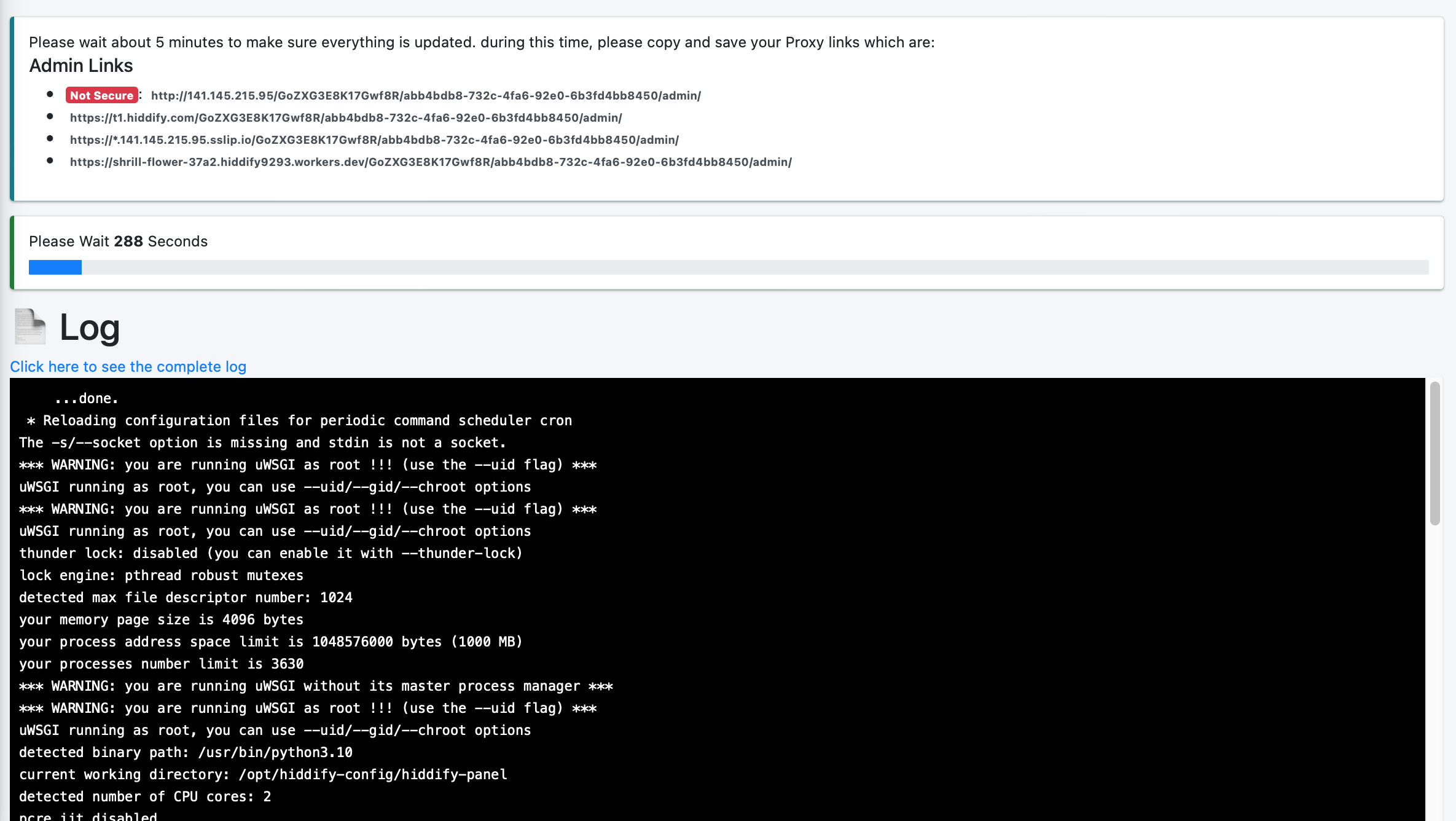
- When it finishes, the page shows your admin links on your domains. They may have changed, so copy them before you leave.
- If the panel no longer opens after a change, connect to your server over SSH and run
hiddify adminto see your current admin links:
- If that does not help, see How to connect and troubleshoot via SSH.
Update Hiddify
Downloads and installs the latest version, then applies it. It takes a while, and the panel restarts at the end. See How to update HiddifyManager.
Reinstall
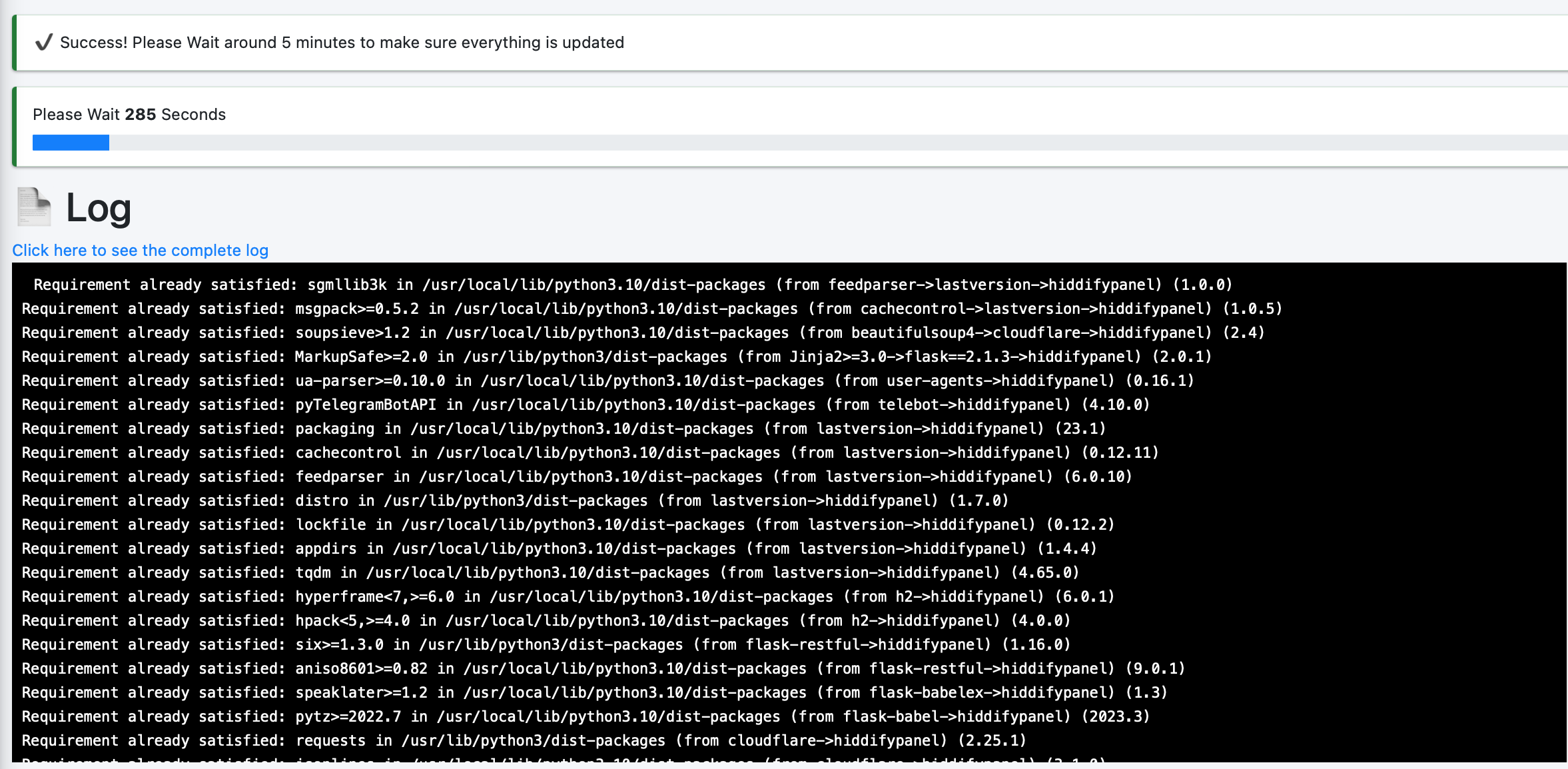
Installs everything again and rebuilds all services. Your users and links are not changed. Use it when Apply changes is not enough, for example after you change the panel path, protocols or a setting marked Reinstall. Connections may drop for a few minutes.
Restart services
Restarts all Hiddify services without reinstalling anything. It is a good first try when something misbehaves. Connections drop for a moment.
Help
All tutorials and videos are listed on the HiddifyManager tutorials page.